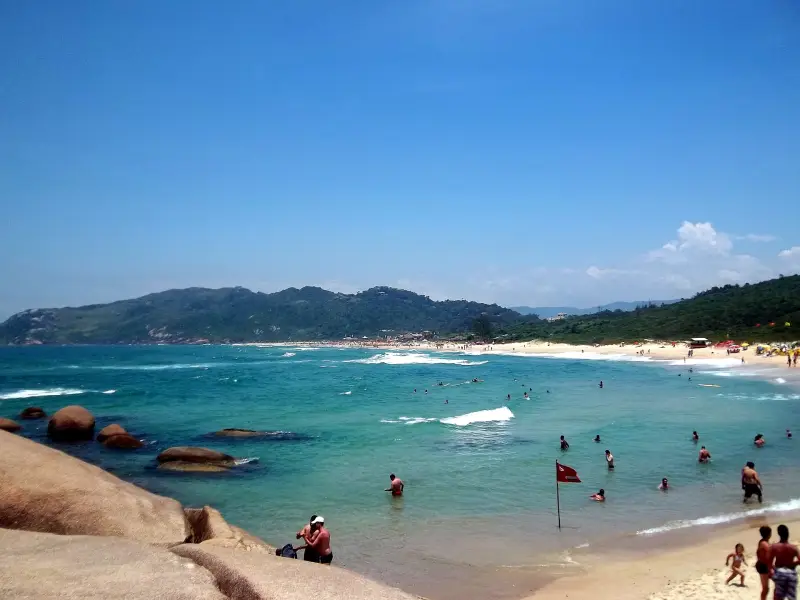
According to the World Surfing Reserve documents, surfing is the second most popular sport in Brazil after football. Santa Catarina and the Rio coast are the two hubs of the scene, and Santa Catarina has the only World Surfing Reserve in Brazil — Guarda do Embaú in Palhoça, about an hour or so from Floripa. Before entering the water, learn the priority rules on the wave and that rip currents remain the main cause of rescue operations.
There are plenty of places to learn in Floripa: Floripa Surf Club (Rua Aconchego do Mar, 60, Barra da Lagoa), Campeche Surf School (Servidão Caminho dos Surfistas), Easy Surf and College Surf School at Joaquina, Ilha da Magia at Santinho. Three more schools with contacts are listed in Where to surf in Florianópolis and Santa Catarina — spots by name and where there are lifeguards.
Guarda do Embaú — World Surfing Reserve
A formal status:
- approved in October 2016, dedicated in October 2019;
- the ninth World Surfing Reserve in the world and the first in Brazil;
- the perimeter contains three waves;
- situated next to the Parque Estadual da Serra do Tabuleiro — the largest protected area in Santa Catarina — with the estuary of the Rio Madre and a mature dune system;
- the hometown of Ricardo dos Santos, the late Brazilian surfer whose name gave the nomination national significance.
Administratively it is Palhoça, that is, the mesoregion Grande Florianópolis, and for an island resident it is a nearby trip, see Santa Catarina — overview of the state and how it is organized (in Russian). More precisely, the village stands in Palhoça, and the beach south of the Rio Madre belongs to Paulo Lopes.
From May to July Guarda do Embaú is closed to surfing. The beach is given over to tainha fishing for that period, according to Save The Waves, and local sources say the same. The Florianópolis law about the tainha season does not extend here; it applies only to the island. Palhoça has its own rule: according to the description of bill 0520/2019 in the Câmara de Palhoça, surfing and other water activities on its beaches and costões are prohibited from 1 May to 15 July. In practice closures are enforced by the fishing ranchos: a red flag means you may not enter the water, and if the fish are late the beach is sometimes left open. For that season Save The Waves recommends Prainha, a small empty beach reached on foot along the shore from the north side of Guarda.
Reserve status carries obligations: the community adopts a management plan that protects the waves, the surfing area and the coastal ecosystem. For a visitor this changes behavior: a reserve is a territory with rules and a very active local community.
Where to surf
Santa Catarina, island of Florianópolis. The eastern beaches are the core of the scene: Joaquina (the historic main spot and competition site), Mole, Campeche, Barra da Lagoa. A breakdown of beaches by zones is given in Florianópolis — a quick guide.
Santa Catarina, the mainland. Guarda do Embaú (Palhoça) and the southern coast — Garopaba, Praia do Rosa in Imbituba, see Santa Catarina coast beyond the island — from Bombinhas to Imbituba.
Rio de Janeiro and the state coast — the second pillar of the scene, including Saquarema, which is called the Brazilian capital of surfing and hosts a World Tour stage.
Northeast — warm water year-round, but the wind scene is stronger there, see Kitesurfing, windsurfing and wingfoil — Brazil's wind scene.
Ranking spots by skill level, wave size and tides is pointless: it is highly seasonal and depends on swell, and a mistake sends a beginner to the wrong place. But there is a named list of SC spots — a list of beaches with their own surf association, together with those that have lifeguards in summer: Where to surf in Florianópolis and Santa Catarina — spots by name and where there are lifeguards.
Tainha season on the island of Florianópolis: a legal ban
On the island of Florianópolis surfing is closed from 1 May to 10 July — the tainha fishing season is in force. This is not a custom or a request from fishermen, but a municipal law: art. 5 of law 4.601/1995 as amended by law 11.142/2024. Since 2024 fishermen have priority not only over surfing but over any water activities and small vessels.
During this period you can freely surf in six stretches: Joaquina and Praia Mole in full, plus 500 meters each at Lagoinha do Leste, Matadeiro, Armação and Moçambique. On other beaches the rancho raises a flag: green — allowed, red — not allowed; which flag is raised is decided by the rancho assembly together with the municipal fishing service. A full table with the limits for each beach is in Where to surf in Florianópolis and Santa Catarina — spots by name and where there are lifeguards.
This matters doubly for visitors: May, June and July are exactly the season when the south gets swell, and people come specifically for the waves.
Discrepancy in sources: 10 or 31 July
The press and city sites name 31 July as the end of restrictions: ND Mais and Imagem da Ilha 30 Apr 2024, Floripa Mil Grau and Guia Ingleses 30 Apr 2026. None of them cites the norm, and for them 31 July is the end of the tainha season generally, as neighbouring towns like Bombinhas also announce it. Fishermen's priority in the water is set not by the tainha season but by art. 5 of law 4.601/1995 as amended by the municipal law 11.142 of 19 Mar 2024, and in it the period is from 1 May to 10 July. This is a Florianópolis law, not a state or federal one.
The text of the article was checked on 30 Sep 2026; on 31 Oct 2026 the chamber site and the law aggregator were again behind a bot check, so it could not be reread. Indirectly 10 July is confirmed by a portaria of the mayor's office for the 2026 season: passenger transport to Ilha do Campeche was suspended from 1 May to 10 July 2026 for fishing (NSC Total, 1 May 2026). The answer is “until 10 July”, and after 10 July, at a beach with a rancho, you should respect the flag and the nets while fishing continues.
Rules in the water — what newcomers don't know
Localism in Brazil is real, and most conflicts arise not from nationality but from violating priority. Basic rules are international:
- priority goes to the one closest to the peak of the wave — they ride, others yield;
- do not "drop in" on someone else's wave — this is the main offense;
- when paddling back, move to the side of the line of riders, not through it;
- do not throw your board — there is a person behind it;
- take turns, and on an overcrowded spot a beginner is better off choosing the edge;
- respect the locals — at a spot with a strong community, like Guarda do Embaú, this is a condition for a calm day.
Beginners do not belong at overcrowded spots. Schools take you out to a suitable area.
Safety — where a surfer is really at risk
Rip currents. According to the Corpo de Bombeiros de Santa Catarina, most drownings at sea are associated with them, and rip currents account for the bulk of rescue operations. Surfers get into them routinely: the current also serves as a "lift" to the peak, which experienced surfers use consciously, and a trap for those who don't understand what is happening.
A full analysis — the mechanics, the rule "swim parallel to the shore", the flag system and an app with a risk map — is in Water and drownings — rip currents, beach flags, what to do. This is required reading before your first outing.
The red flag means a ban on entering the water, and it applies to surfers as well.
Sharks — a local issue on the Greater Recife coast, not the whole country; according to the CEMIT committee table, surfers and bathers are almost equally represented among victims. Details are in Dangerous animals — snakes, scorpions, spiders, jellyfish and sharks of Recife (in Russian).
If you want to compete
You cannot just walk up and enter an official competition: you need an application through the state's sports structure, and it must be submitted in advance. Amateur and school events operate under their own rules and are easier to enter, and you learn about them at a surf school or from the association of your beach.
Sources
- T1Save The Waves Coalition — Guarda do Embaú: approval 2016, dedication 2019, ninth World Surfing Reserve; adjacent to Parque Serra do Tabuleiro; surfing as the second most popular sport in Brazil; from May to July the beach is allocated to the mullet fishery and surfing is not allowed, alternative — Prainha to the northsavethewaves.org · primary source
- T1Confederação Brasileira de Surf — structure: state federations, circuits, rulebooks, anti-doping and sports courtcbsurf.org.br · primary source
- T1Corpo de Bombeiros Santa Catarina — rip currents, flags and rescue statisticscbm.sc.gov.br · primary source
- T1Florianópolis law 10.020/2016 — ban on surfing from 1 May to 10 July outside six sectionssistemas.sc.gov.br · primary source
- T1Florianópolis law 11.142 of 19 Mar 2024 — new art. 5 of law 4.601/1995: from 1 May to 10 July priority for tainha (mullet) fishing over all water sports and small vessels, free sections, green and red rancho flagscmf.sc.gov.br · primary source
- T2NSC Total, 1 May 2026 — Portaria of the Secretaria do Meio Ambiente of the Prefeitura de Florianópolis: transport to Ilha do Campeche suspended from 1 May to 10 July 2026 for the tainha (mullet) fishing seasonnsctotal.com.br · secondary source
- T3ND Mais, 30 Apr 2024 — «until 31 July», ban on all water sports; rule not named. Source of discrepancy, not a referencendmais.com.br · other
T1 — primary: law, agency site, price list. T2 — secondary: press, specialist sites. T3 — other.