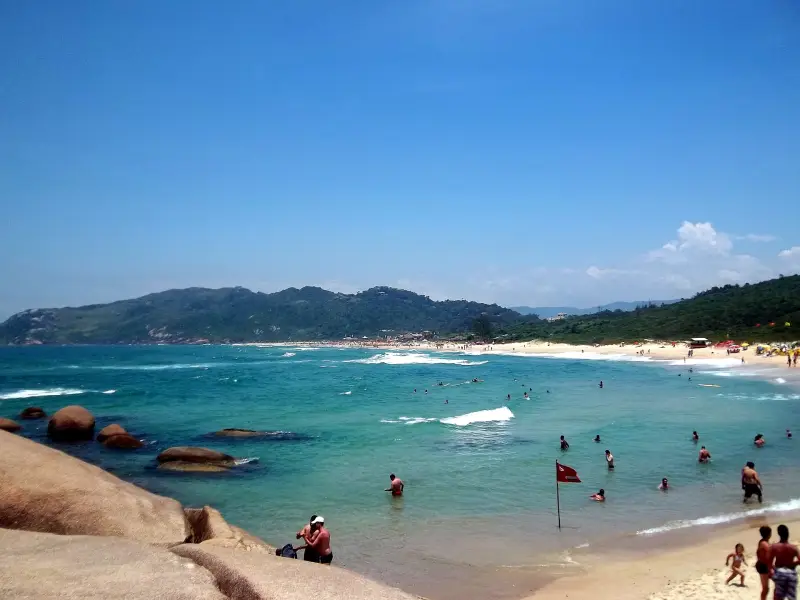
The main danger on Brazilian beaches, ahead of sharks and crime, is rip currents: according to the Corpo de Bombeiros de Santa Catarina the majority of drownings in salt water are associated with them. There is one rule and it is counterintuitive: do not swim against the current. Swim parallel to the shore or stay afloat and call for a lifeguard. In the 2024/2025 season, seven of the nine people who died drowned in places without lifeguard posts.
⚠️ This is prevention, not medical instruction. Resuscitation techniques are not included here — they are taught in courses, not in the text.
Rip currents: what they are and why they're dangerous
Mechanism. Water that arrives at the shore with waves looks for a concentrated way back to the sea. A “corridor” forms that pulls a person out of the shallow water in seconds.
The danger is not that the person is being drowned. The danger is that they quickly become exhausted trying to swim against the flow.
The stronger the waves, the stronger the current. The volume of water coming to the shore equals the volume that must return: the bigger and higher the waves, the more powerful the backflow.
What to do if you're being pulled out
Steps recommended directly by the Corpo de Bombeiros:
- Do not panic and do not fight the current — it is stronger than you.
- Wave your arm to call a lifeguard.
- Swim parallel to the shore — across the “corridor”, not against it.
- Or simply stay afloat and wait for help.
Original phrasing: “Do not waste your energy trying to swim against the current, because it is stronger than you.”
Beach flags: how to find out in advance if it is safe
On beaches with lifeguards, places with rip currents are marked with red flags, which prohibit entering the water.
| Flag | What it means |
|---|---|
| Green | low risk of drowning |
| Red | rip current, high risk — do not enter the water |
| Purple | presence of jellyfish |
CBMSC Cidadão app. The Corpo de Bombeiros runs a free app where you can see which flag is on each beach — split into high, medium and low risk — and places with jellyfish. The idea is to choose the beach before leaving home, not after: check in the morning where the green flag is today, and go there.
The numbers
Season 2024/2025, from 16 December to 15 January (CBMSC data):
- 1,818 rescues from drowning — in salt and fresh water;
- 9 deaths: 7 at sea, 2 in fresh water, another 4 cases were under investigation;
- of the 9 deceased, 7 — in places not covered by lifeguard posts;
- places of death at sea: Itapoá (three cases), São Francisco do Sul, Florianópolis (two), Garopaba; in fresh water — São João Batista and Itajaí.
Season 2025/2026, from 15 December to 18 January: 1,289 cases of people dragged by a rip current and 42 drownings with resuscitation — a total of 1,331 rescues. A year earlier for the same period there were 2,190 such cases, i.e. a decrease of about 41%, and the Corpo de Bombeiros associates this with stronger signage and public outreach.
The state expects up to 3.1 million visitors in the high season — hence the scale.
What decides is the place, not swimming ability. Swim where there is a lifeguard post.
Children
A separate recommendation from the Corpo de Bombeiros, because the risk profile is different: even a weak current will carry a child away.
- The child should be in shallow water;
- and no farther than an outstretched arm from the adult.
At CBMSC lifeguard posts child identification bracelets are issued free of charge — they are worth taking.
The largest number of cases is not among children, but among young adults aged 24–25. Self-confidence is an independent risk factor.
Jellyfish
The purple flag and the app show their presence. The scale can be significant: in one week in January the number of jellyfish incidents rose from 1,047 to 2,036.
What to do in case of a sting — in Dangerous animals — snakes, scorpions, spiders, jellyfish and sharks of Recife (in Russian), where jellyfish and Portuguese men-of-war are covered as a category in Ministry of Health records.
Who to call
- 193 — firefighters and rescuers: water rescue, injuries, everything that requires extraction and rescue operations.
- 192 — SAMU: clinical cases (heart attack, stroke).
The distinction is explained directly by the Corpo de Bombeiros itself: injuries and rescue — 193, clinical — 192; in the absence or unavailability of SAMU call the firefighters. General list of emergency numbers — in Safety in Brazil — statistics, scam schemes, rules of conduct (in Russian).
Fresh water too
Drownings in rivers, waterfalls and lagoons are included in the same statistics and accounted for 2 of the 9 deaths for the season. Lagoons and waterfalls are usually not supervised at all, and currents and depth changes there are not visible from the shore.
Sources
- T1Corpo de Bombeiros Santa Catarina — rip currents as the main risk factor: mechanism, behavior rules, children, Operação Estação Verão statisticscbm.sc.gov.br · primary source
- T1Corpo de Bombeiros Santa Catarina — CBMSC Cidadão app and flags, rescue and death statistics by location for the 2024/2025 seasoncbm.sc.gov.br · primary source
- T1Corpo de Bombeiros Santa Catarina — emergency numbers and distinction between calling 193 and 192cbm.sc.gov.br · primary source
T1 — primary: law, agency site, price list. T2 — secondary: press, specialist sites. T3 — other.