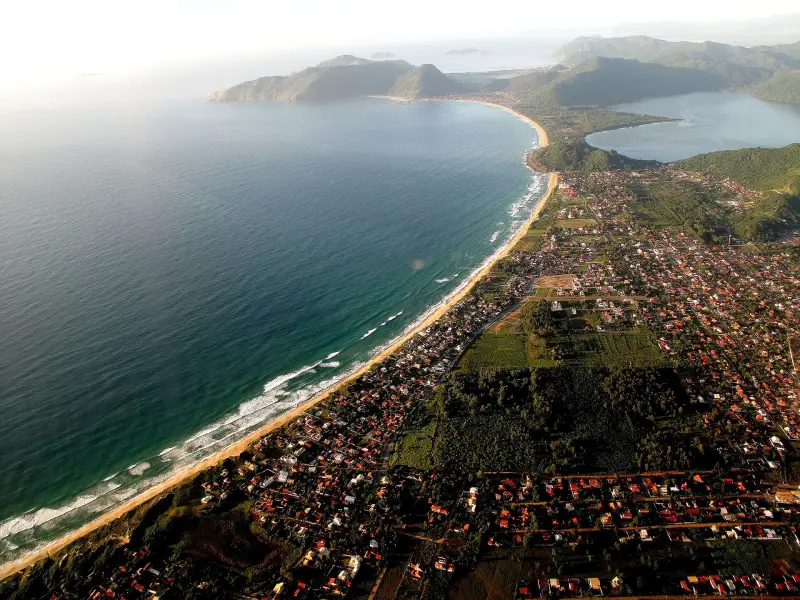
The first capital of Brazil and the center of Afro-Brazilian culture: candomblé, capoeira, acarajé, the most powerful street carnival in the country. Culturally it is perhaps the most interesting city in the country. But it requires sobriety: in the state of Bahia the rate is 36.8 murders per 100,000, almost five times higher than São Paulo, and five baiano cities are in the national top-10 most dangerous cities. You must choose where to stay and how to move around consciously.
1. Basics
- State: Bahia (BA)
- Airport: SSA (Luís Eduardo Magalhães), terminus of metro line 2
- How many days: 3–4 for the city, more — if going to Morro de São Paulo or to Chapada Diamantina
- Best season: Sep–Mar. From Apr to Jul heavy rains — this is significant, see When and where to go — the "month × region" matrix
2. Attractions
Pelourinho — the historic center and a UNESCO site: colonial pastel-colored houses, cobblestones, churches. The oldest and most colourful quarter of the city. You must go there by day; in the evening with caveats (see the safety section).
Elevador Lacerda — an 1873 elevator connecting the Upper and Lower city. It works as ordinary public transport, costs next to nothing, and gives a panorama of Baía de Todos os Santos. A symbol of the city.
Farol da Barra stands on a rocky headland, has operated since 1698 and is considered the oldest lighthouse in the Americas. Inside is a maritime museum. The most photographed point of Salvador and the best place for sunset.
Igreja do Senhor do Bonfim — the main church of Bahia's syncretic religiosity. The fence is hung with thousands of fitas, those very ribbons that people take as souvenirs, see Souvenirs from Brazil — what to bring and where to get them.
Mercado Modelo — the handicraft market in the Lower city.
What is worth seeing live: circles of capoeira, rehearsals of Afro bloco (Olodum in Pelourinho on Tuesdays — a historical tradition), street baianas de acarajé.
3. Safety
Requires special attention.
- The state of Bahia — 36.8 murders per 100,000, one of the three worst in the country. Five cities of the state are in the national top-10, including the resort Porto Seguro. This is the background, not a direct threat to a tourist, but it explains the level of caution required.
- Pickpockets in tourist spots: the entrances and exits of Elevador Lacerda, Mercado Modelo, Pelourinho. They operate purposefully here.
- Pelourinho in the evening — only in busy areas and with company; side streets are not for strolling.
- Street vendors and “guides” by the Elevador are intrusive — refuse politely and do not engage in conversations about “special tours”.
- Stay close to the center of events. Salvador is huge; remote cheap accommodation means trips through neighbourhoods where a tourist has no business.
- Taxis only via apps, especially in the evening.
General rules are set out in Safety in Brazil — statistics, fraud schemes, rules of conduct.
4. Transport
- Salvador's metro has two lines, daily 5:00–0:00, fare R$ 4.10. Line 2 reaches the airport — it's a way to leave SSA without a taxi. The historic centre and Barra are not covered by the metro.
- The main transport for the tourist is Uber and 99.
- Elevador Lacerda and the funicular Plano Inclinado — not only attractions, but working transport between the Upper and Lower city.
- Ferry from the Lower city — to the island Itaparica and to Morro de São Paulo.
5. Food
Bahia has the most distinctive cuisine in Brazil, and it is the main reason to come here after the culture.
- Acarajé from the street baianas — a must. They will ask “quente?” — that's about the hot sauce
- Moqueca baiana — with dendê and coconut milk
- Vatapá, caruru, bobó de camarão, casquinha de siri
- Rio Vermelho — the gastronomic and bar district, also home to the most famous acarajé spots
More on this in What to try in Brazil.
6. Accommodation
| Neighborhood | For whom |
|---|---|
| Barra / Farol da Barra | Best choice for a first trip: everything within walking distance, beach, infrastructure, calmer |
| Rio Vermelho | Bohemian, gastronomy and nightlife, many guesthouses |
| Ondina | Between Barra and Rio Vermelho, hotels on the coast |
| Pelourinho / Centro Histórico | Maximum atmosphere, but noisy and requires greater caution in the evening |
| Santo Antônio | Quieter and calmer than the historic centre, further from the hotspots |
| Itapuã | If you specifically need a good beach, but far from the historic centre |
7. Money, healthcare and communication
Money. Cards are accepted in establishments, cash is needed with baianas, at the market and on the beach. See Money in Brazil — currency exchange, cards, Pix, cash withdrawal.
Healthcare. Ambulance 192. Private hospitals in the Barra and Itaigara areas. With insurance — go there.
Connectivity. Coverage in the city is normal. On trips out — Morro de São Paulo, in Chapada Diamantina connectivity drops in places.
Carnival
The largest street carnival in the world and the city's main event. Officially 4–9 Feb 2027, pre-carnival from 29 Jan. There are three circuits: Dodô (from Barra to Ondina), Osmar (Campo Grande), Batatinha (Pelourinho, without trio-elétrico). Everything is detailed in Carnival 2027 — dates and breakdown by cities.
On carnival dates accommodation prices rise several times, you should book six months in advance.
Sources
- T2cnnbrasil.com.brcnnbrasil.com.br · secondary source
- T2dicasdabahia.com.brdicasdabahia.com.br · secondary source
- T1forumseguranca.org.brforumseguranca.org.br · primary source
- T1trilhos.motiva.com.brtrilhos.motiva.com.br · primary source
- T2correio24horas.com.brcorreio24horas.com.br · secondary source
T1 — primary: law, agency site, price list. T2 — secondary: press, specialist sites. T3 — other.
Spotted a mistake?
Know when this article changes
Rules and prices change. Once a week: what changed in this article and what's on in the city. No Telegram. We send a confirmation link first.